✱ What Is Yoga? Simple Explanation for Beginners
Yoga is an ancient practice that improves physical health, mental peace and flexibility. Learn the meaning of yoga, its types, benefits and how to practice yoga daily. The word “Yoga” means union — a deep connection with your breath, your inner self, and your natural state of peace.
In today’s fast-paced life, yoga is not just physical exercise; it is a holistic lifestyle that reduces stress, increases energy, and enhances overall well-being.
Yoga helps improve flexibility, strength, mental clarity, emotional balance, and inner calm. This makes it suitable for everyone — students, professionals, homemakers, and even senior citizens.
✤ Why Yoga is Important Today?
Modern lifestyle creates issues like:
- High stress
- Low physical movement
- Poor posture
- Irregular routines
Yoga naturally restores balance without any side effects and helps you feel healthier, lighter, and mentally focused.
✤ How to Do Yoga? (Step-by-Step Guide for Beginners)
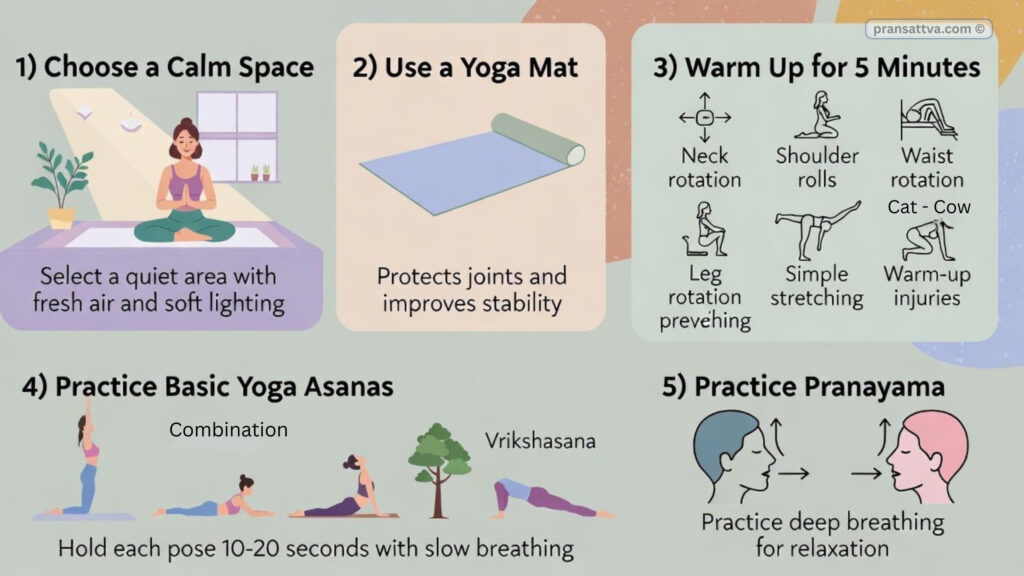
1) Choose a Calm Space
Select a peaceful area with fresh air and soft lighting.
2) Use a Yoga Mat
To protect your joints and maintain stability.
3) Warm Up for 5 Minutes
- Neck rotations
- Shoulder rolls
- waist rotation
- leg rotation
- Simple stretching
- cat cow rotation
This prevents injuries.
4) Practice Basic Yoga Asanas
Start with simple poses like:
- Mountain Pose (Tadasana)
- Cobra Pose (Bhujangasana)
- Child’s Pose (Balasana)
- Tree Pose (Vrikshasana)
- Bridge Pose (Setu Bandhasana)
Hold each pose for 10–20 seconds with slow breathing.
5) Practice Pranayama (Breathing Exercises)
- Anulom Vilom
- Bhastrika
- Kapalbhati
These boost lung capacity and calm the mind.
6) End With Relaxation (Shavasana)
5 minutes of deep relaxation rejuvenates your body and mind.
✤ Best Time to Do Yoga
☑ Morning – Best
- Stomach is empty
- Mind is fresh
- Energy stays stable all day
☑ Evening – Also Good
Helps release the stress collected throughout the day.
☒ Avoid Yoga
- Immediately after heavy meals
- During illness without medical advice
- If you have sharp or severe pain
✤ Benefits of Yoga (Advantages)
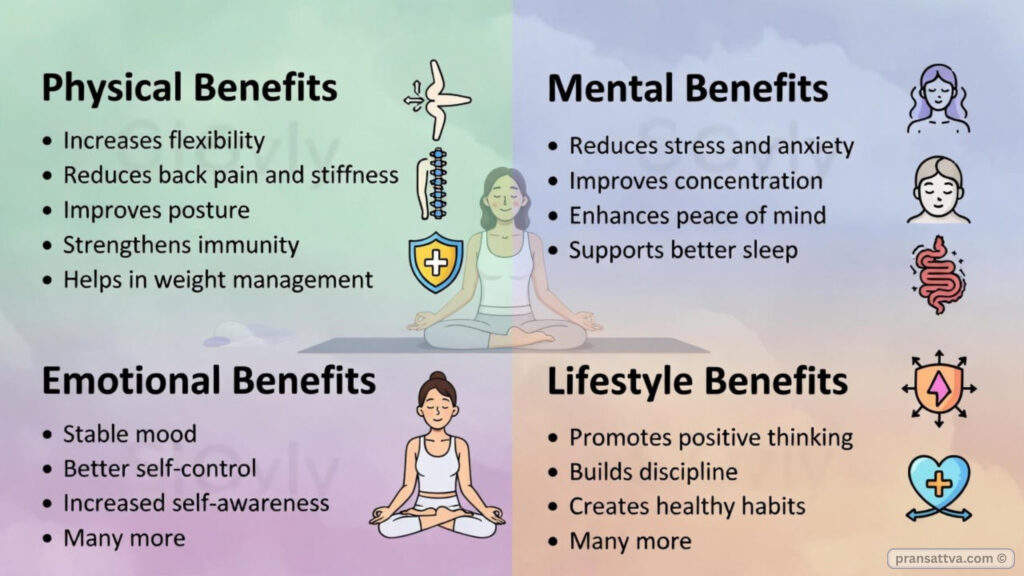
1) Physical Benefits
- Increases flexibility
- Reduces back pain and stiffness
- Improves posture
- Strengthens immunity
- Helps in weight management
- Improves digestion
- Many More
2) Mental Benefits
- Reduces stress and anxiety
- Improves concentration
- Enhances peace of mind
- Better sleep
- Many More
3) Emotional Benefits
- Stable mood
- Better self-control
- Increased self-awareness
- Many More
4) Lifestyle Benefits
- Promotes positive thinking
- Builds discipline
- Creates healthy habits
- Many More
✤ Characteristics of Yoga
- Holistic approach: Heals body, mind, and emotions together
- No equipment required: Just a mat
- Suitable for all ages
- Safe and natural
- Both preventive and healing
✤ Precautions While Doing Yoga
- Do not rush; move slowly and gently
- If you feel pain, stop immediately
- Keep breathing steady
- Pregnant women should follow guided yoga & consult to Doctor.
- People with heart or BP issues should consult experts
Yoga is a natural way to integrate the body, mind, and soul. With regular practice, you can improve your flexibility, strength, focus, peace of mind, and emotional stability.
Including yoga in your daily routine is one of the best steps towards a healthier and happier life.
✤ Types of Yoga and Their Asanas
Beginner Yoga: Safe Yoga Poses to Improve Flexibility & Strength
👉 Reason:
- Slow pace
- Alignment & awareness focus
- Physical strain kam
- Beginners, seniors, healing ke liye best
1) Hatha Yoga Asanas
The foundation of all physical yoga styles, focusing on simple poses and breathing.
Hatha Yoga is one of the most popular types of yoga practiced worldwide.
- Tadasana (Mountain Pose) – Improves posture and balance.
- Vrikshasana (Tree Pose) – Builds stability and focus.
- Trikonasana (Triangle Pose) – Strengthens legs and enhances flexibility.
- Bhujangasana (Cobra Pose) – Opens the chest and reduces back stiffness.
- Paschimottanasana (Seated Forward Bend) – Stretches the spine and hamstrings.
- Padmasana (Lotus Pose) – Enhances meditation and calmness.
- Dhanurasana (Bow Pose) – Strengthens the back and boosts energy.
- Halasana (Plow Pose) – Improves digestion and flexibility.
2) Iyengar Yoga Asanas
Focuses on perfect alignment using props like blocks and belts.
Alignment-based yoga, often using props.
Salamba Sarvangasana (Shoulder Stand) – Enhances thyroid function.
Utthita Trikonasana – Deep triangle pose with perfect alignment.
Ardha Chandrasana – Balances and strengthens legs.
Parsvottanasana – Stretches spine and shoulders.
Salamba Sirsasana (Headstand) – Improves blood flow to brain.
3) Yin Yoga Asanas
Slow, deep stretching targeting connective tissues.
Deep stretching poses held for long duration.
- Butterfly Pose – Opens hips and groin.
- Dragon Pose – Deep hip flexor stretch.
- Sphinx Pose – Gentle backbend to release tension.
- Caterpillar Pose – Forward fold for deep hamstring stretch.
4) Restorative Yoga Asanas
Gentle poses held for longer durations to deeply relax the body.
Relaxing poses using cushions and props.
- Supported Child’s Pose – Calms the mind instantly.
- Supported Bridge Pose – Relaxes lower back.
- Legs-Up-The-Wall (Viparita Karani) – Reduces stress and improves circulation.
- Supported Reclining Bound Angle Pose – Deep heart opener.
5) Prenatal Yoga Asanas
Safe yoga designed specifically for pregnant women.
Safe poses for pregnant women.
- Cat-Cow Stretch – Reduces back pain.
- Modified Warrior Pose – Builds stamina gently.
- Butterfly Stretch – Opens pelvic muscles.
- Side-Lying Savasana – Relaxes the body safely.
6) Jnana Yoga (Knowledge Yoga)
No asanas — Yoga of knowledge and self-inquiry.
7) Bhakti Yoga (Devotion Yoga)
Yoga of devotion and spiritual love.
No physical poses — involves chanting & meditation.
8) Karma Yoga (Action Yoga)
Yoga of selfless action without expecting results.
Focuses on selfless action, not physical asanas.
9) Raja Yoga (Meditation Yoga)
Focuses on meditation and controlling the mind.
Includes deep meditation postures:
- Padmasana (Lotus Pose) – Stabilizes the mind.
- Sukhasana (Easy Pose) – Comfortable for long meditation.
- Vajrasana – Improves digestion and concentration.
Advanced Yoga Asanas Step-by-Step for Strength, Stability & Focus
10) Vinyasa Yoga Asanas
A fast, flow-based style where movement follows breath.
Flow-based yoga where each movement follows breath.
- Surya Namaskar (Sun Salutation) – Full-body warm-up flow.
- Chaturanga Dandasana – Strengthens arms and core.
- Utkatasana (Chair Pose) – Builds leg strength.
- Adho Mukha Svanasana (Downward Dog) – Stretches whole body.
- Urdhva Mukha Svanasana (Upward Dog) – Opens chest and improves posture.
- Plank Pose – Improves core stability.
11) Ashtanga Yoga Asanas
A structured, intense form of yoga with fixed pose sequences.
Structured and powerful series of poses.
- Primary Series (Yoga Chikitsa)
- Padangusthasana
- Marichyasana A, B, C, D
- Janu Sirsasana
- Navasana (Boat Pose)
- Setu Bandhasana
- Intermediate Series
- Kapotasana
- Eka Pada Sirsasana
- Pincha Mayurasana
12) Power Yoga Asanas
A modern, fast-paced, strength-building yoga style.
Fast-paced strength-building yoga.
- Power Plank – Strengthens core.
- Warrior I (Virabhadrasana I) – Builds strength in legs.
- Warrior II (Virabhadrasana II) – Enhances stamina.
- Side Plank (Vasisthasana) – Strengthens obliques and arms.
13) Bikram Yoga Asanas (26 Poses)
A series of 26 poses performed in a heated room.
- Half Moon Pose
- Awkward Pose
- Eagle Pose
- Standing Bow
- Triangle Pose
- Camel Pose
- Rabbit Pose
14) Kundalini Yoga Asanas
A combination of movement, chanting, and breath to awaken inner energy.
Energy-activating movements with breath and mantra.
- Spinal Flex – Awakens spinal energy.
- Ego Eradicator Pose – Opens lungs and boosts mental clarity.
- Kundalini Lotus Pose – Activates inner energy flow.
15) Mandala Yoga Asanas
Circular movements to balance energy flow in the body.
Circular movement-based poses.
- Circular Flow Lunge – Opens hips.
- Mandala Forward Fold – Stretches hamstrings.
- 360° Warrior Flow – Increases balance and cooling energy.
✤ Frequently Asked Questions (FAQ)
1) What is Yoga?
Yoga is an ancient Indian practice that connects the body, mind, and breath through physical postures, breathing exercises, and meditation for complete well-being.
2) Is Yoga suitable for beginners?
Yes. Beginners can start with simple poses like Tadasana, Balasana, and Vrikshasana and gradually move to advanced asanas.
3) What is the best time to do Yoga?
The best time is early morning on an empty stomach, but evening yoga is also effective for stress relief.
4) How often should I practice Yoga?
Practicing 3–5 times a week is ideal, but even 10–15 minutes daily can make a difference.
5) Can Yoga help with weight loss?
Yes. Yoga styles like Vinyasa, Power Yoga, and Ashtanga burn calories, boost metabolism, and support weight loss.
6) Do I need equipment to start Yoga?
No. You only need a yoga mat and comfortable clothing.
7) Can pregnant women do Yoga?
Yes, but only Prenatal Yoga under the guidance of a trained instructor. Always follow your doctor’s advice.
8) Is Yoga good for back pain?
Gentle poses like Cat-Cow, Cobra, and Child’s Pose help relieve back pain.
Avoid intense twisting or forward bending if you have severe pain.
9) How long should a Yoga session be?
A normal yoga session ranges from 30–60 minutes. Beginners can start with shorter sessions.
10) What should I eat before doing Yoga?
Yoga should be done on an empty stomach. If needed, eat something light like a fruit 1–2 hours before practice.
11) Can Yoga help reduce stress and anxiety?
Yes. Yoga and pranayama activate the relaxation response and help calm the mind instantly.
12) Is Yoga religious?
No. Yoga is a spiritual and wellness science. Anyone from any religion can practice it.
13) Can Yoga improve height?
Yoga improves posture, reduces spine compression, and makes you appear taller and more aligned.
14) What is Pranayama?
Pranayama is yogic breath control that improves lung capacity, mental clarity, and emotional stability.
15) How long does it take to see results from Yoga?
Most people experience improvements in 10–14 days, including better flexibility, reduced stress, and improved sleep.