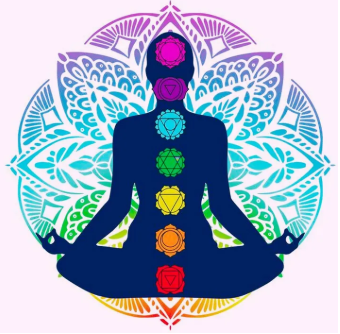
Deep Concentration Meditation is an advanced practice to build strong focus and mental stability. Learn how it works, benefits, and step-by-step practice.
✱ What Is Deep Concentration Meditation?
Deep Concentration Meditation is an advanced meditation practice that trains the mind to focus steadily on a single object or point of attention for an extended period.
Unlike basic mindfulness, which allows awareness to remain open, deep concentration meditation develops one-pointed attention, helping the mind become stable, clear, and undistracted.
This practice is recommended for practitioners who already have experience with beginner or intermediate meditation.
✤ How Deep Concentration Meditation Works
Deep Concentration Meditation works by repeatedly bringing the mind back to one chosen focus point.
During practice:
- Attention is placed on a single object (such as breath, sound, or awareness point)
- Distractions are noticed but not followed
- Focus is gently restored again and again
Over time, this strengthens the mind’s ability to remain stable, clear, and deeply attentive.

✤ Why Deep Concentration Meditation Is Considered Advanced
This meditation is classified as advanced because:
- It requires sustained attention
- Mental discipline is essential
- Distractions must be handled internally
- Longer sitting duration is needed
A strong foundation in breath awareness or mindfulness meditation is important before starting.
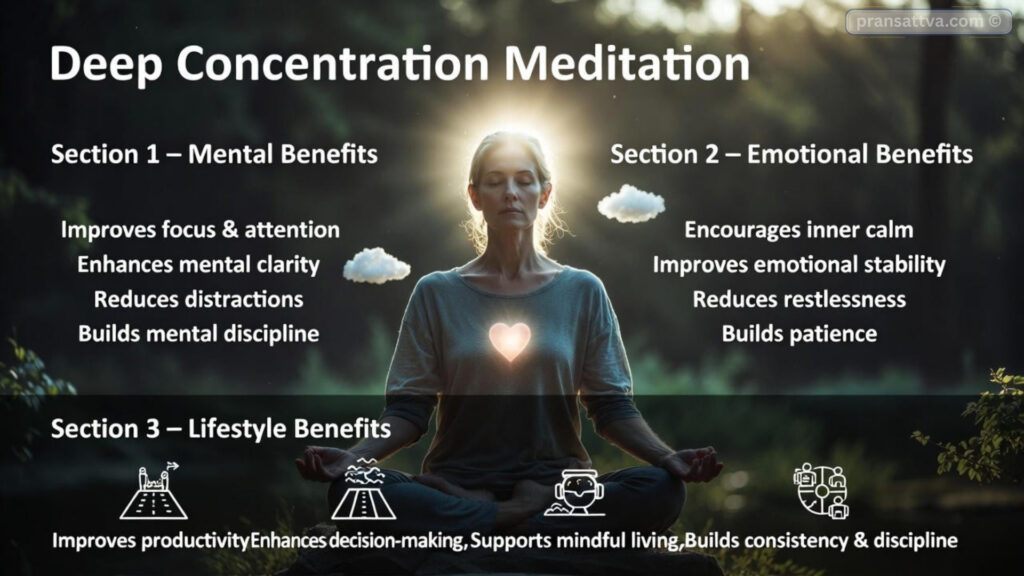
✤ Benefits of Deep Concentration Meditation
1) Mental Benefits
- Sharpens focus and attention
- Improves mental clarity
- Reduces mental distractions
- Strengthens mental discipline
2) Emotional Benefits
- Encourages inner calm
- Improves emotional stability
- Reduces restlessness
- Builds patience
3) Lifestyle Benefits
- Improves productivity
- Enhances decision-making
- Supports mindful living
- Builds consistency and discipline
✤ Key Characteristics of Deep Concentration Meditation
- Single-point focus practice
- One object of attention
- Mostly unguided
- Longer practice duration
- Requires meditation experience
This meditation develops mental strength and focus mastery.
✤ Common Objects Used in Deep Concentration Meditation
The object should be simple and non-distracting, such as:
- Natural breathing sensation
- A neutral sound
- A visual point
- An internal awareness point
The same object should be used consistently.
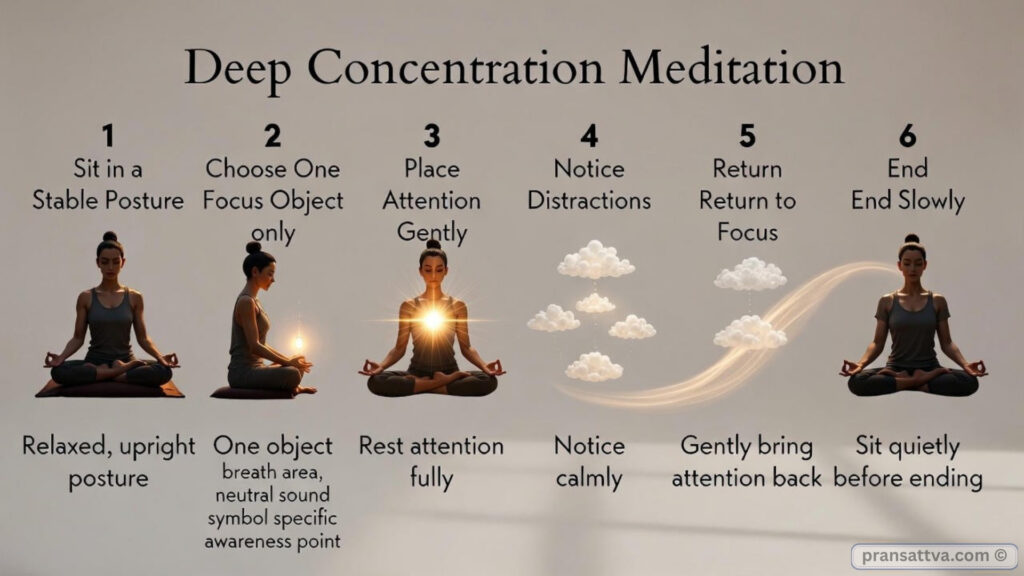
✤ How to Practice Deep Concentration Meditation (Step-by-Step)
Step 1: Sit in a Stable Posture
Sit comfortably with a straight but relaxed spine.
Step 2: Choose One Focus Object
Select a single point of attention (breath, sound, or awareness).
Step 3: Place Attention Gently
Rest your attention fully on the chosen object.
Step 4: Notice Distractions
When the mind wanders, calmly notice it.
Step 5: Return to Focus
Gently bring attention back to the object without frustration.
Step 6: End Slowly
After practice, sit quietly for a few moments.
Recommended duration:
Start with 15–20 minutes, gradually increase to 30–40 minutes.
 Best Time to Practice Deep Concentration Meditation
☑ Early Morning (Best Time)
- Mind is calm and fresh
- Fewer distractions
- Ideal for deep focus
☑ Evening
- Suitable for experienced practitioners
☒ Avoid Practice
- When mentally exhausted
- Immediately after heavy meals
⚠️ Common Mistakes to Avoid
- Forcing concentration
- Changing focus object frequently
- Getting frustrated with distractions
- Practicing irregularly
Deep concentration develops through patience and consistency.
✤ Deep Concentration vs Mindfulness Meditation
- Concentration meditation uses single-point focus
- Mindfulness meditation uses open awareness
- Concentration builds focus; mindfulness builds awareness
Both practices support each other in advanced meditation.
Conclusion
Deep Concentration Meditation is a powerful advanced practice for developing strong focus, clarity, and mental stability.
By training the mind to stay with one point of attention, this meditation builds discipline, patience, and deep inner calm.
With regular practice, deep concentration becomes a valuable foundation for higher awareness and mindful living.