✱ What Is Pranayama? Meaning, Definition & Yogic Philosophy
What isWhat is Pranayama?
Pranayama is one of the foundational pillars of yoga, designed to help you control, expand, and refine your breath.
The word “Pranayama” comes from two Sanskrit words:
➙ Ayama – control or expansion
➙ Prana – life energy
Using breath to balance the flow of energy throughout the body.
This ancient practice has a profound impact on the body, mind, and emotions, making it an ideal starting point for beginners who want to experience the deeper benefits of yoga.
According to yogic philosophy, pranayama purifies the energy channels (nadis), calms the mind, and enhances overall vitality.
From a scientific perspective, slow and deep breathing activates the nervous system, which instantly reduces stress and promotes relaxation.
✤ How Pranayama Works: Breath, Energy & Nervous System Balance
Pranayama According to Yogic Philosophy, Pranayama from a Modern Scientific Perspective
➙ Slow, mindful breathing instantly activates the parasympathetic nervous system,
➙ Reduces the stress hormone cortisol,
➙ Improves heart and lung efficiency.
This combination of yogic wisdom and scientific validation is the reason why doctors and wellness experts around the world recommend pranayama for a healthier lifestyle.
✱ Benefits of Pranayama for Body, Mind & Energy
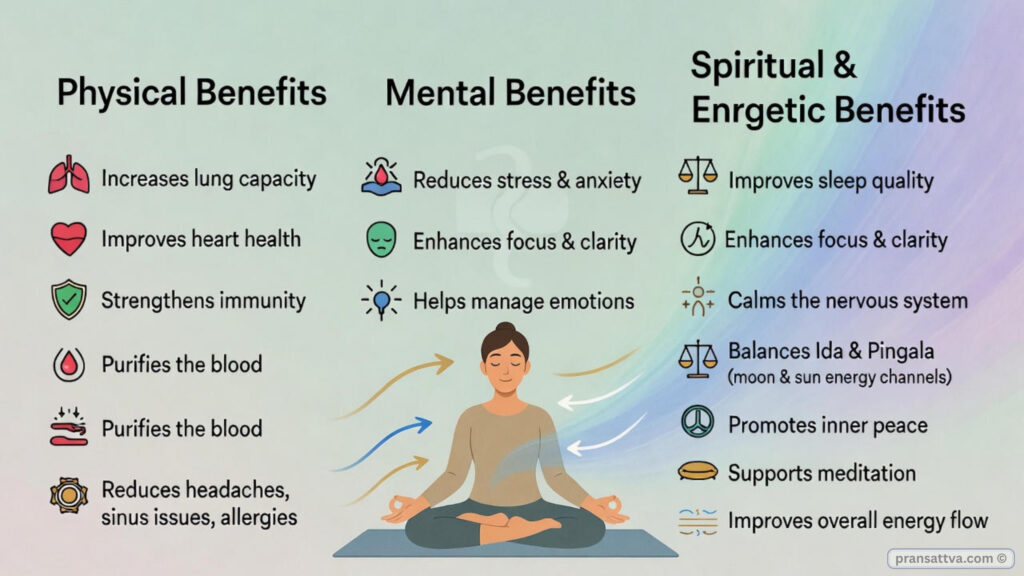
✤ Physical Benefits of Pranayama
- Increases lung capacity
- Improves heart health
- Strengthens immunity
- Purifies the blood
- Provides relief from headaches, sinus issues, and allergies
- Supports better digestion
✤ Mental Benefits of Pranayama
- Reduces stress & anxiety
- Improves sleep quality
- Enhances focus & clarity
- Helps manage emotions
- Calms the nervous system
✤ Mental Benefits of Pranayama
- Balances Ida & Pingala (moon & sun energy channels)
- Promotes inner peace
- Supports meditation
- Improves overall energy flow
 Best Time to Practice Pranayama for Maximum Benefits
Choosing the right time for pranayama greatly enhances its benefits.
According to yogic principles, pranayama is most effective when the mind is calm, the stomach is light, and the environment is peaceful.
Here are the ideal timings for maximum results:
☑ Early Morning Pranayama (Brahma Muhurta) – 4:00 AM to 6:00 AM
This is considered the best time for pranayama.
☑ Why it’s ideal:
- The air is fresh and pure
- The mind is naturally quiet
- Energy channels open more easily
- Concentration and awareness are higher
Morning pranayama sets a positive tone for the entire day.
☑ Pranayama After Sunrise (6:00 AM to 9:00 AM)
If waking up very early is difficult, this is an excellent alternative.
Benefits:
- Natural warmth helps the breath flow smoothly
- Ideal for beginners
- Reduces morning stress and anxiety
☑ Pranayama After Sunrise (Before Sunset – 5:00 PM to 7:00 PM)
Pranayama in the evening helps release accumulated stress from the day.
Ideal for:
- Mental exhaustion
- Work fatigue
- Emotional imbalance
- Nervous tension
Evening pranayama also supports better sleep.
☑ Pranayama Before Bed (Gentle Practices Only)
Light breathing practices before sleep help calm the mind.
Suitable techniques:
- Deep Breathing
- Full Yogic Breath
- Gentle Nadi Shuddhi
Benefits:
- Reduces mental overactivity
- Helps unwind after a long day
- Improves sleep quality
⚠️ Avoid energizing practices like Bhastrika or Kapalbhati at night.
⚠️ When NOT to Practice Pranayama
Avoid pranayama during:
- A full stomach (after meals)
- Immediately after heavy exercise
- Extreme exhaustion
- Very hot, cold, or polluted environments
- Dehydration
For best results, practice on an empty or light stomach.
Ideal Pranayama Routine for Maximum Results
| Practice Type | Best Time |
|---|---|
| Basic Breathing | Morning / Evening |
| Nadi Shuddhi | Morning & Before Bed |
| Anulom Vilom | Morning & Evening |
| Bhastrika | Early Morning Only |
| Kapalbhati | Morning (empty stomach) |
| Meditation + Pranayama | After sunrise |
Conclusion
The most effective time for pranayama is early morning, followed by early evening.
Consistent practice during these times purifies the nadis, balances the mind, and builds long-term physical, emotional, and mental well-being.
✤ General Precautions for Safe Pranayama Practice
- Avoid practicing right after meals
- Sit with a straight spine
- Do not strain your breath
- If dizzy, stop immediately
- Pregnant women should avoid breath retention
- People with high BP should avoid forceful practices like Kapalbhati & Bhastrika
✤ Beginner-Friendly Pranayama Sequence (Safe & Effective)
If you’re new, start with this simple sequence:
- Deep Breathing – 2 minutes
- Anulom Vilom – 5 minutes
- Bhramari – 3 minutes
- Sheetali / Sheetkari – 1 minute
This routine is safe, calming, and effective.
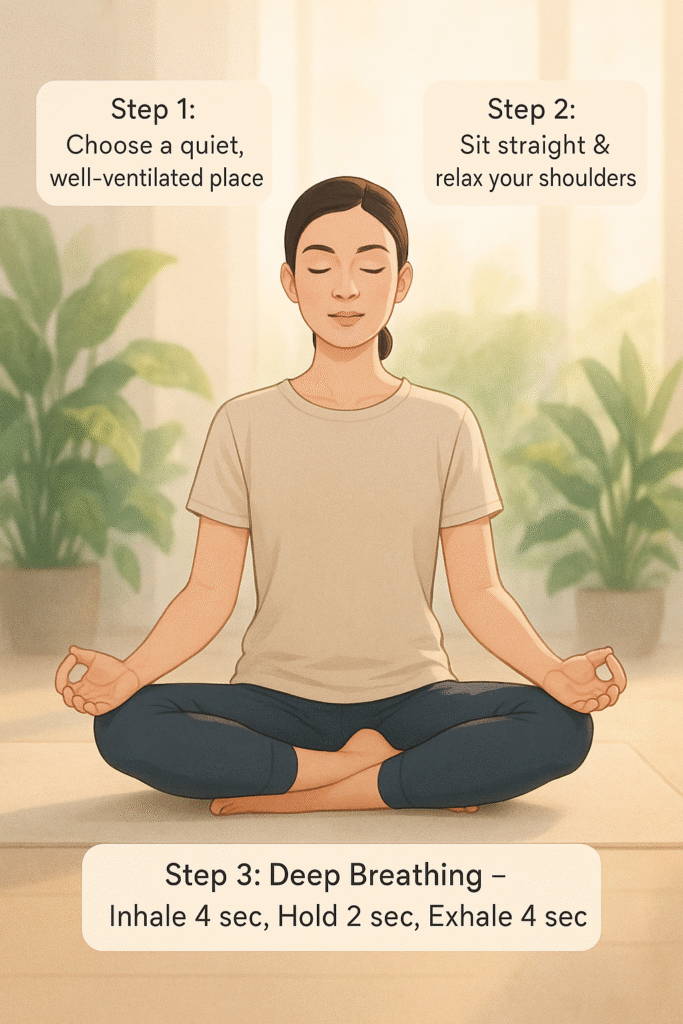
Step 1 – Choose the Right Environment
- Sit in a peaceful, well-ventilated space
- You may sit in Sukhasana, Padmasana, or on a chair with “yoga mat” or “aasan”.
Step 2 – Correct Posture for Pranayama
- Keep your spine comfortably straight
- Relax your shoulders
- Close your eyes gently
- Observe your natural breath for a few moments
Step 3 – Begin with Deep Breathing (2 minutes)
- Inhale for 4 seconds
- Hold for 2 seconds (Pregnant lady should avoid to hold breathing, She may breath continue)
- Exhale for 4 seconds (Pregnant lady should avoid to hold breathing, She may breath continue)
This simple warm-up prepares your mind and lungs for further practice.
✱ Types of Pranayama: Complete List of 45 Breathing Techniques
The Ultimate Beginner-to-Advanced List (With Categories & Descriptions)
Pranayama is an essential limb of Yoga that deals with controlled breathing to regulate the flow of prana—the vital life force. Different types of pranayama serve different purposes such as calming the mind, energizing the body, cooling internal heat, balancing emotions, and preparing for meditation.
Below is the complete, category-wise list of all 45 pranayama types, along with a short description and “Read More” placeholders for your website pages.
✤ 1. Beginner / Basic Breathing Pranayama (6 Types)
Below are the six best pranayamas for beginners, Safe, easy & best to start with.
- Deep Breathing – Slow full breaths that relax the body and calm the mind.
👉 Read More - Diaphragmatic (Abdominal) Breathing – Belly-rising breath that strengthens the diaphragm and improves lung efficiency.
👉 Read More - Thoracic Breathing – Breathing that expands the rib cage and increases lung capacity.
👉 Read More - Clavicular Breathing – Shallow upper-lung breathing used during stress or emotional imbalance.
👉 Read More - Full Yogic Breath – Combines belly, chest, and upper chest breathing into one complete breath cycle.
👉 Read More - Anulom Vilom – Balances left–right brain hemispheres and calms the nervous system.
👉 Read More
✤ 2. Nadi Shuddhi & Energy Channel Activation Pranayama (6 Types)
These pranayamas balance Ida–Pingala–Sushumna Nadis.
- Nadi Shodhana – Cleanses & purifies the subtle energy channels.
👉 Read More - Ida Nadi Breathing – Left-nostril breath for cooling & relaxation.
👉 Read More - Pingala Nadi Breathing – Right-nostril breath for heat & activation.
👉 Read More - Sushumna Breath – Breath to activate the central energy channel.
👉 Read More - Right-start Anulom Vilom – Activates Surya (Pingala) Nadi for heat & focus.
👉 Read More - Left-start Anulom Vilom – Activates Chandra (Ida) Nadi for calmness.
👉 Read More
✤ 3. Cooling Pranayama Techniques (3 Types)
Best for summer, anger, heat, acidity & stress.
- Sheetkari Pranayama – Cooling breath through teeth.
👉 Read More - Chandra Bhedana – Left-nostril inhalation to reduce body heat.
👉 Read More - Chandra Nadi Pranayama – Deep cooling moon-energy breath.
👉 Read More
✤ 4. Heating & Energizing Pranayama Techniques (4 Types)
Good for winter, low energy & dullness.
- Surya Bhedana – Right-nostril inhale to increase warmth & metabolism.
👉 Read More - Surya Nadi Pranayama – Sun-energy breath for activation & alertness.
👉 Read More - Bhastrika Variants – Intense inhale-exhale to boost vitality.
👉 Read More - Strong Kapalbhati – Rapid exhalation that heats and energizes the body.
👉 Read More
✤ 5. Relaxation & Meditative Pranayama Techniques (6 Types)
Best for stress, anxiety, anger & insomnia.
- Udgeeth Pranayama – OM chanting breath for profound relaxation.
👉 Read More - Pranava Pranayama – Sound-vibration breathing for inner balance.
👉 Read More - Ajapa Japa Breath – Spontaneous breath awareness with mantra.
👉 Read More - Ujjayi Meditation Breath – Slow throat breathing for concentration.
👉 Read More - Bhramari with Shanmukhi Mudra – Deep calming humming breath.
👉 Read More - Mindful Breath Awareness – Breath observation linked with meditation.
👉 Read More
✤ 6. Ratio & Rhythmic Pranayama Techniques (5 Types)
Best for nervous system regulation.
- Sama Vritti – Equal inhale & exhale.
👉 Read More - Visama Vritti – Unequal breath ratios like 1:2 or 1:4.
👉 Read More - Box Breathing – 4-4-4-4 breath pattern.
👉 Read More - Triangle Breathing – 3-phase breath (inhale-hold-exhale).
👉 Read More - 1:4:2 Breathing – Traditional advanced ratio for deep breath control.
👉 Read More
✤ 7. Classical Hatha Yoga Pranayama (8 Traditional Techniques)
(From Hatha Yoga Pradipika – the most authentic list)
These 8 are considered the original classical pranayamas.
- Suryabhedi Pranayama – Right-nostril inhalation to generate heat and strength.
👉 Read More - Ujjayi Pranayama – Ocean-like breath for mental focus and relaxation.
👉 Read More - Sheetali Pranayama – Cooling breath through rolled tongue to reduce internal heat.
👉 Read More - Bhastrika Pranayama – Fast inhale–exhale to boost energy and metabolism.
👉 Read More - Bhramari Pranayama – Humming sound breathing to calm the mind and relieve stress.
👉 Read More - Moorchha Pranayama – Deep relaxation breath that induces a meditative trance.
👉 Read More - Plavini Pranayama – Air-holding technique that creates buoyancy and lightness.
👉 Read More - Kapalbhati Pranayama – Active exhalation technique for detox & digestion.
👉 Read More
✤ 8. Advanced & Rare Pranayama Techniques (7 Types)
Only for trained practitioners.
- Kevali Kumbhaka – Breathless state during deep meditation.
👉 Read More - Sahita Kumbhaka – Breath retention with inhalation or exhalation.
👉 Read More - Antar Kumbhaka – Internal breath-hold after inhalation.
👉 Read More - Bahya Kumbhaka – External breath-hold after exhalation.
👉 Read More - Agni Sara Pranayama – Fire-activating breath with abdominal motion.
👉 Read More - Viloma Pranayama – Interrupted inhale/exhale in segments.
👉 Read More - Moorchha Advanced – Deep trance-like breath control using retention.
👉 Read More
TOTAL PRANAYAMA TYPES: 45
✱ FAQ: Types of Pranayama
❓ Why are there so many types?
Because each pranayama influences a different system—lungs, nerves, mind, digestion, heat, cooling, meditation & energy channels.
❓ Which pranayama is best for beginners?
Anulom Vilom, Deep Breathing, Full Yogic Breath & Bhramari.
❓ Which pranayama burns heat/energy?
Surya Bhedana, Bhastrika, Kapalbhati.
❓ Which pranayama cools the body?
Sheetali, Sheetkari, Chandra Bhedana.